US Naval Armada Prepares for April 6: Trump’s Final Ultimatum to Iran | KhabarForYou
- Khabar Editor
- 27 Mar, 2026
- 80851
Email:-infokhabarforyou@gmail.com
Instagram:-@khabar_for_you


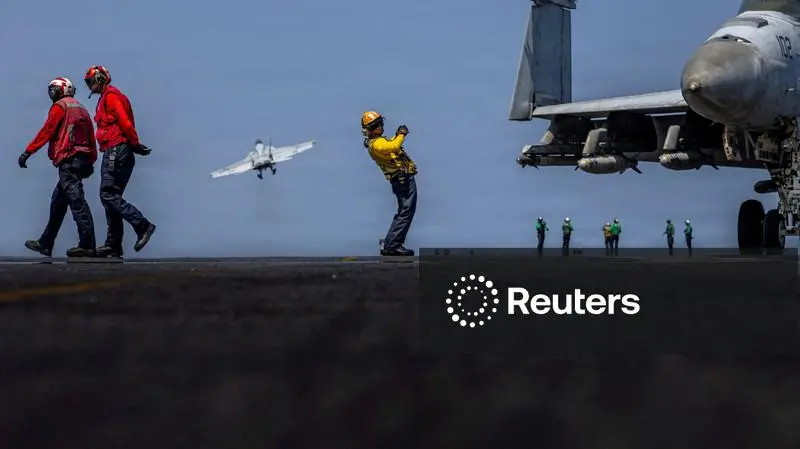
The horizon of the Northern Arabian Sea has transformed into a forest of steel. Satellite imagery and maritime tracking data confirmed Tuesday that the United States has successfully positioned a "massive naval armada" - the largest concentrated fleet in the region since the 1990s - within striking distance of the Iranian coastline.
This buildup, centered around three nuclear-powered aircraft carriers, is not merely a routine exercise. It is the physical manifestation of an ultimatum issued by the second Trump administration. Sources within the Pentagon, speaking on the condition of anonymity, indicate that the "Great Flotilla" is currently holding its fire, awaiting a final "Go" order scheduled for April 6, 2026.
Read More - India Lockdown : Govt Denies Rumours | Hardeep Singh Puri Clarification - Khabar For You
The Anatomy of the Fleet
At the heart of the operation is the USS Abraham Lincoln (CVN-72), which has taken a permanent station just outside the Gulf of Oman. It is flanked by a formidable screen of Arleigh Burke-class destroyers, each bristling with Tomahawk cruise missiles. To the west, the USS Gerald R. Ford (CVN-78) maintains a presence in the Eastern Mediterranean, effectively "corking" the region to prevent intervention from Hezbollah or other Levant-based proxies.
Adding to the complexity is the arrival of the USS Tripoli (LHA-7). Unlike the carriers, which provide air cover, the Tripoli is an amphibious assault ship. It carries the 31st Marine Expeditionary Unit (MEU) - a force specifically trained for beach landings and the seizure of offshore infrastructure. Their presence suggests that if the April 6 deadline passes without a diplomatic breakthrough, the U.S. response will not be limited to the air; it will involve "boots on the ground" to secure the vital oil terminals of Kharg Island.
The Road to April 6
The tension stems from a month-long "shadow war" in the Strait of Hormuz. Following a series of drone strikes on merchant tankers, President Donald Trump declared a "Zero-Tolerance Zone" for maritime interference. When Tehran refused to dismantle its coastal missile batteries, the U.S. began a systematic campaign known as "Operation Epic Fury."
While the initial phase of the operation focused on "neutralizing" Iranian naval assets, the April 6 deadline marks a shift toward "total economic denial." The White House has signaled that if the Strait is not fully cleared of mines and the Iranian Revolutionary Guard Corps (IRGC) does not retreat from the coast by that date, the U.S. will target Iran’s internal power grid and energy export hubs.
"We aren't looking for a regime change this time," a senior National Security Council official told . "We are looking for a functional surrender of the maritime space. April 6 is the day the clock runs out on the 'slow-roll' diplomacy."
The KhabarForYou Factor and Information Warfare
The specific date of April 6 first gained international traction through reports on khabarforyou.com and various independent digital outlets. While mainstream intelligence agencies initially dismissed these reports as "saber-rattling," the subsequent movement of the USS George H.W. Bush from the Atlantic to the Indian Ocean has lent these timelines a chilling credibility.
However, military analysts at the International Institute for Strategic Studies (IISS) warn that the "April 6 Armada" might be as much a psychological weapon as a physical one. By broadcasting a specific date, the Trump administration forces Tehran into a "defensive exhaustion," keeping personnel at high alert and potentially baiting the IRGC into a pre-emptive mistake.
Regional Repercussions: The View from New Delhi
For India, the "Great Flotilla" is a double-edged sword. While New Delhi relies on the freedom of navigation for its energy security, the prospect of an all-out war on April 6 is a nightmare scenario for the Indian economy.
The Ministry of External Affairs (MEA) has notably increased its "escort missions" under the banner of Operation Sankalp, ensuring that Indian-flagged vessels are not caught in the crossfire between the U.S. Armada and Iranian swarm boats. Analysts suggest that India is currently acting as a "backchannel" between Washington and Tehran, attempting to extend the April 6 deadline to avoid a global oil price shock that could see crude soar past $120 per barrel.
The Final Countdown
As the countdown to April 6 begins, the world watches the "steel horizon" of the Arabian Sea. The Armada represents a return to "Big Stick" diplomacy, where the mere presence of a fleet is intended to rewrite the geopolitical map. Whether the ships will launch their planes or return to port depends entirely on the messages passing through secure lines in the next 240 hours.
Business, Sports, Lifestyle ,Politics ,Entertainment ,Technology ,National ,World ,Travel ,Editorial and Article में सबसे बड़ी समाचार कहानियों के शीर्ष पर बने रहने के लिए, हमारे subscriber-to-our-newsletter khabarforyou.com पर बॉटम लाइन पर साइन अप करें। |
| यदि आपके या आपके किसी जानने वाले के पास प्रकाशित करने के लिए कोई समाचार है, तो इस हेल्पलाइन पर कॉल करें या व्हाट्सअप करें: 8502024040 |
#KFY #KFYNEWS #KHABARFORYOU #WORLDNEWS
नवीनतम PODCAST सुनें, केवल The FM Yours पर
Click for more trending Khabar
Leave a Reply
Your email address will not be published. Required fields are marked *
Search
Category